Sunday, March 17, 2013

Xenophyophores

Xenophyroes Image NOOA wikimedia


For your convenience I copy first paragraph of the wikipedia article
Xenophyophores are giant unicellular organisms found throughout the world's oceans, at depths of up to 10,641 meters (6.6 miles). When first described in 1889, the xenophyophores were placed with the sponges. Later they were classified as testate amoeboids (Arcellinida), then in their own phylum of Protista.

A recent genetic study suggests the xenophyophores are a specialized group of Foraminifera.

Xenophyophores are found in the greatest numbers on the abyssal plains of the deep ocean. They are placed in two orders in 13 genera with approximately 42 recognized species; one species,

Syringammina fragilissima, is among the largest known single-celled organisms at up to 20 centimetres in diameter.
Read the entire wikipedia article from here


Mariana Trench

Mariana Trench
Image wikimedia

"The deepest place in the ocean is teeming with microscopic life, a study suggests.

An international team of scientists found that the very bottom of the Mariana Trench, which lies almost 11km (7 miles) down in the Pacific Ocean, had high levels of microbial activity.

The research is published in the journal Nature Geoscience.

The underwater canyon was once thought to be too hostile an environment for life to exist.

But this study adds to a growing body of evidence that a range of creatures can cope with the near-freezing temperatures, immense pressures and complete darkness.

Dr Robert Turnewitsch, one of the authors of the paper from the Scottish Association for Marine Science, said: "The deepest parts of the deep sea are certainly not dead zones."
Rebecca Morelle
BBC Science news March 18, 2013 


Wikipedia tells about the environment in this deepest trench on Earth
The Mariana Trench or Marianas Trench is the deepest part of the world's oceans. It is located in the western Pacific Ocean, to the east of the Mariana Islands. The trench is about 2,550 kilometres (1,580 mi) long but has an average width of only 69 kilometres (43 mi). It reaches a maximum-known depth of 10.911 km (10,911 ± 40 m) or 6.831 mi (36,069 ± 131 ft) at the Challenger Deep, a small slot-shaped valley in its floor, at its southern end, although some unrepeated measurements place the deepest portion at 11.03 kilometres (6.85 mi).

At the bottom of the trench the water column above exerts a pressure of 1,086 bars (15,750 psi), over one thousand times the standard atmospheric pressure at sea level. At this pressure the density of water is increased by 4.96%, making ninety-five litres of water under the pressure of the Challenger Deep contain the same mass as a hundred litres at the surface. The temperature at the bottom is 1 to 4 ⁰C.

The trench is not the part of the seafloor closest to the center of the Earth. This is because the Earth is not a perfect sphere: its radius is about 25 kilometres (16 mi) less at the poles than at the equator.[5] As a result, parts of the Arctic Ocean seabed are at least 13 kilometres (8.1 mi) closer to the Earth's center than the Challenger Deep seafloor.

Xenophyophores have been found in the trench by Scripps Institution of Oceanography researchers at a record depth of 10.6 km (6.6 mi) below the sea surface. In 17 March 2013, researchers reported data that suggested microbial life forms thrive in the Mariana Trench. Other researchers reported related studies that microbes thrive inside rocks up to 1900 feet below the sea floor under 8500 feet of ocean off the coast of the north western United States. According to one of the researchers,"You can find microbes everywhere — they're extremely adaptable to conditions, and survive wherever they are."

Read the entire wikipedia article from here


Tuesday, March 5, 2013

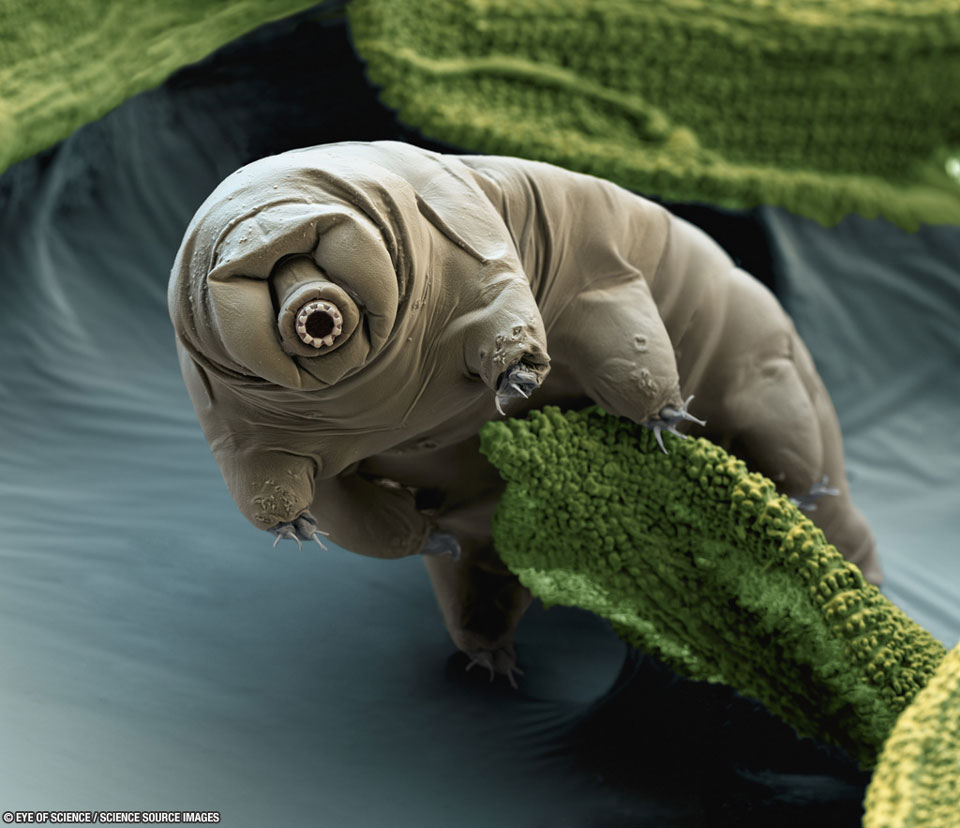
Tardigrade!

Tardigrade!
Image Eye of Science APOD 
"Is this an alien? Probably not, but of all the animals on Earth, the tardigrade might be the best candidate. That's because tardigrades are known to be able to go for decades without food or water, to survive temperatures from near absolute zero to well above the boiling point of water, to survive pressures from near zero to well above that on ocean floors, and to survive direct exposure to dangerous radiations...."
March 6, 2013 APOD 

Bookmarked here because IMHO this is the most striking and educational image so far in the glorious gallery of APOD 2013.


Wednesday, December 5, 2012

Raindrops and early air


Another God and natural life bookmark
Earth 2.7 billion years ago was very different from the planet we know today.

It spun much faster, the Moon was closer and the Sun was much weaker. And there were no animals or plants in existence back then; the air was simply not breathable.

"There was probably quite a bit of nitrogen in the atmosphere, like today, but there was no oxygen," explained Sanjoy Som from Nasa's Ames Research Center.

"The oxygen was likely replaced by greenhouse gases such as carbon dioxide and methane.

"My palaeobarometry work cannot tell you precisely what the gases were, but it will assist modellers of atmospheric composition by giving them a constraint," he told BBC News.

Dr Som told the AGU meeting - the largest annual gathering of Earth scientists - that the "fossil raindrops" were discovered in Ventersdorp in the North West Province of South Africa in the 1980s.

Jonathan Amos BBC Science and Environment December 5 2012
Fossil raindrops probe ancient atmosphere


Nyasasaurus parringtoni

Nyasaurus parringtoni
Image BBC Science and Environment 

Another God and natural life bookmark

BBC Science and Environment December 5 2012
New contender for oldest dinosaur

Tuesday, November 27, 2012

Lake Vida (Antarctica)

Geologist walking in Lade Vida region
Image © 2003 National Geographic

Another God and natural life bookmark Antarctic lake
The discovery of microbes thriving in the salty, sub-zero conditions of an Antarctic lake could raise the prospects for life on the Solar System's icy moons.

Researchers found a diverse community of bugs living in the lake's dark environment, at temperatures of -13C.

Furthermore, they say the lake's life forms have been sealed off from the outside world for some 2,800 years.

Details of the work have been outlined in the journal PNAS.

Lake Vida, the largest of several unique lakes found in the McMurdo Dry Valleys, contains no oxygen, is acidic, mostly frozen and possesses the highest nitrous oxide levels of any natural water body on Earth.
Paul Rincon
BBC Science & Environment 27.11.2012

For more images and a map showing the location of Lake Vida see this link


Thursday, November 1, 2012

Natural body and spiritual body

Some Epicurean and Stoic philosophers standing at Areopagus found it quite amusing when the invited guest speaker talked about resurrection of the dead. Some of the listeners were curious, however, and wanted to hear more.
When they heard about the resurrection of the dead, some of them sneered, but others said, “We want to hear you again on this subject.” At that, Paul left the Council. Some of the people became followers of Paul and believed. Among them was Dionysius, a member of the Areopagus, also a woman named Damaris, and a number of others.
Acts 17:32-33 NIV
Little did the philosophers present in this Hyde Park session know that in not so distant future this strange religious message would take over not only the entire Greece but the entire world!

What might St Paul have said more about the subject of resurrection in Athens then is written in Acts 17 we do not know. But we do have an authentic letter from him self addressed to early Christians living in the great city of Corinth and dated by scholars to early 50'ies AD. In that letter St Paul talks about natural body known to us all and about something quite different, a spiritual body.
"So will it be with the resurrection of the dead. The body that is sown is perishable, it is raised imperishable; it is sown in dishonor, it is raised in glory; it is sown in weakness, it is raised in power; it is sown a natural body, it is raised a spiritual body.

If there is a natural body, there is also a spiritual body. So it is written: “The first man Adam became a living being”; the last Adam, a life-giving spirit.

The spiritual did not come first, but the natural, and after that the spiritual.

The first man was of the dust of the earth; the second man is of heaven. As was the earthly man, so are those who are of the earth; and as is the heavenly man, so also are those who are of heaven.

And just as we have borne the image of the earthly man, so shall we bear the image of the heavenly man.

I declare to you, brothers and sisters, that flesh and blood cannot inherit the kingdom of God, nor does the perishable inherit the imperishable. Listen, I tell you a mystery: We will not all sleep, but we will all be changed— in a flash, in the twinkling of an eye, at the last trumpet."
First Corinthians 15:42-52 NIV